Stroke Helper,
The app that can save lives.
Saarland - Gesundheit 2030
Stroke Helper beim Digitalisierungskongress
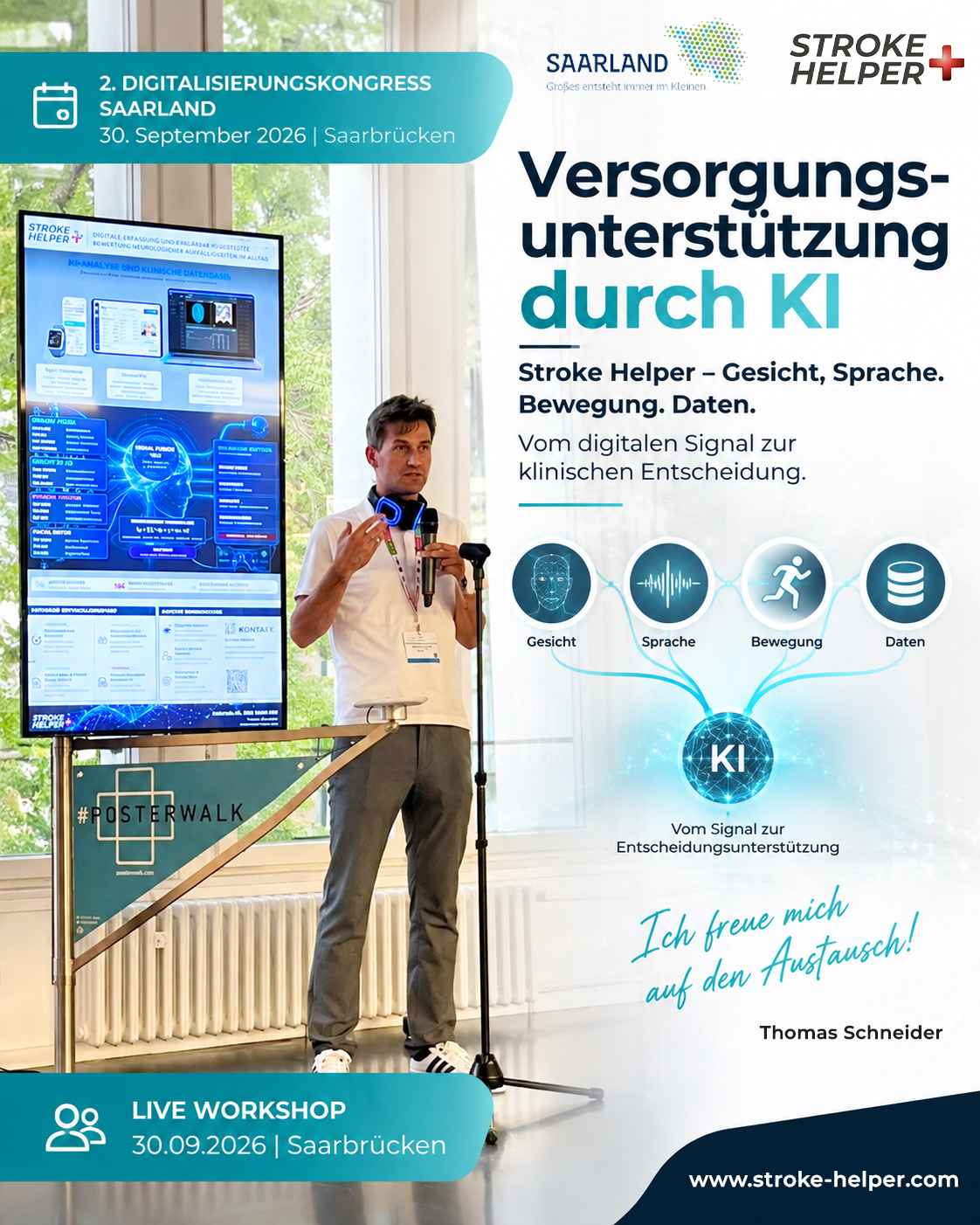
Am 30. September 2026 wird Stroke Helper beim 2. Digitalisierungskongress Saarland – Gesundheit 2030 vorgestellt. Im Mittelpunkt der Veranstaltung stehen innovative Technologien, künstliche Intelligenz und die Frage, wie die medizinische Versorgung von morgen gestaltet werden kann.
Im Rahmen des Workshops „Versorgungsunterstützung durch KI – Stroke Helper: Gesicht. Sprache. Bewegung. Daten. – Vom digitalen Signal zur klinischen Entscheidung“ geben wir Einblicke in die Entwicklung und Funktionsweise unserer KI-gestützten Plattform zur digitalen Erfassung und Bewertung neurologischer Auffälligkeiten.
Dabei zeigen wir, wie Informationen aus Gesicht, Sprache, Motorik, Vitalwerten und weiteren gesundheitsbezogenen Daten strukturiert erfasst und innerhalb unserer Signal Fusion zusammengeführt werden. Ein besonderer Schwerpunkt liegt auf der erklärbaren Aufbereitung der Ergebnisse und dem Human-in-the-Loop-Ansatz: Die KI soll medizinische Fachkräfte unterstützen, relevante Veränderungen sichtbar machen und zusätzliche Informationen für die klinische Beurteilung bereitstellen – nicht die ärztliche Entscheidung ersetzen.
Mit der mobilen Anwendung, Clinical Pro und dem Intelligence Lab verfügt Stroke Helper bereits über ein funktionsfähiges technologisches Ökosystem. Der Digitalisierungskongress bietet uns die Gelegenheit, diesen Ansatz einem interdisziplinären Publikum aus Medizin, Forschung, Gesundheitswesen, Technologie und Politik vorzustellen und gemeinsam über die nächsten Schritte in Richtung klinischer Validierung und praktischer Versorgungsintegration zu diskutieren.
GESICHT. SPRACHE. BEWEGUNG. DATEN. – VOM DIGITALEN SIGNAL ZUR KLINISCHEN ENTSCHEIDUNG.
Vom statischen Scan zur dynamischen Analyse
Erfassung der Gesichtsmotorik
Mit dem neuen Facial Motor Scan erweitern wir die Gesichtserfassung von Stroke Helper um eine entscheidende Dimension: Bewegung. Während gezielter mimischer Aufgaben – beispielsweise Lächeln oder dem Schließen der Augen – werden Veränderungen in der Gesichtsmotorik strukturiert erfasst und für spätere Vergleiche aufbereitet.
In Verbindung mit unserem 3D Face Scan, rund 2.500 Gesichtspunkten und einem dreidimensionalen Mesh, entsteht so die Grundlage, um Symmetrien und motorische Veränderungen künftig auch im zeitlichen Verlauf differenziert betrachten zu können.
Ein weiterer Schritt auf dem Weg von der Momentaufnahme zur longitudinalen neurologischen Betrachtung.
Why rapid help matters.
Facts you should know.
200,000 new cases annually
In Germany, around 200,000 people suffer a stroke for the first time each year - many of them completely unexpectedly. A rapid response can save lives and prevent long-term damage.
* Quelle: Stiftung Deutsche Schlaganfall-Hilfe
Detect faster – treat better
Time is brain” — in the event of a stroke, every minute counts: approximately 32,000 neurons die in the brain each second. The earlier it is recognized, the better the chances of recovery.*
* Quelle: PubMed – National Library of Medicine
Help when no one is watching.
Many stroke patients are alone at the critical moment – Stroke Helper helps with detection*, even when no doctor is nearby. Simple. Fast. Digital.
⚠️ Important note: StrokeHelper does not replace no medical diagnosis.
The app can only detect symptoms and indicate possible signs of a stroke.
In case of suspected stroke, always: call emergency services immediately!
App currently available in 7 languages - more coming soon.
Speech-Based Analysis Instead of Translation
Stroke Helper’s speech recognition is not based on translated test sentences –
but on language-specific sound patterns and phonetic structures.
A separate reference is created for each supported language.
This takes into account typical sounds, syllable patterns, and articulation characteristics of the respective language.
This enables language-specific changes – such as those associated with aphasic symptoms – to be detected in a differentiated and reliable manner.
Independent of the user’s language or background.
Good to know
Stroke Helper is already usable as a prototype – but not yet officially available in the App Store.
I’m continuing to develop the app and improve it step by step.
Features at a glance
Onboarding with risk assessment
Right from the initial setup, Stroke Helper analyzes your personal risk factors – anonymously and in compliance with data protection regulations.
Facial analysis
Detect asymmetric facial movements or paralysis using the camera – similar to the FaceID setup.
Speech analysis
Compare current speech with your stored reference – if slurred speech is detected, a warning is issued.
Symptom checklist
With just a few questions, you can check for additional warning signs – easy to use, even in stressful moments.
HealthKit integration
Uses existing data such as age, weight, or medications – for a more accurate risk assessment.
MIRA – First Aid Coach
If the app detects possible stroke symptoms, MIRA guides you step by step through first aid measures - following the well-known ABCDE protocol.
The lab behind the scenes
MIRA AI
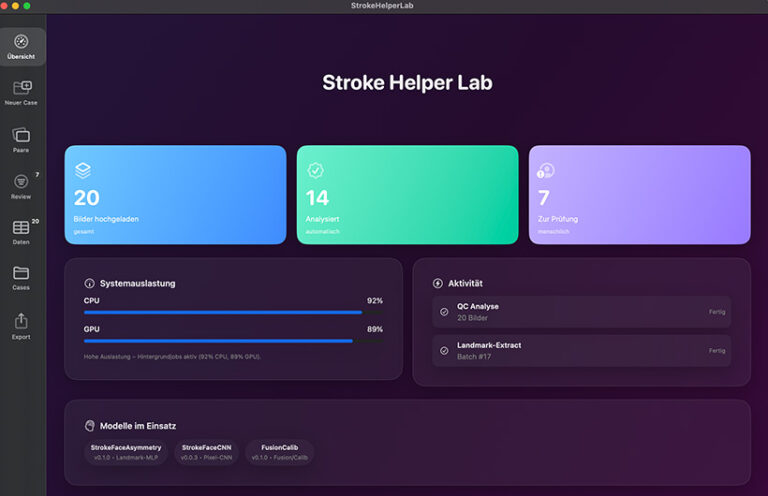
MIRA AI is the analytical foundation of Stroke Helper and a proprietary in-house development.
Here, data is validated, models are trained, and new features are continuously developed.