AI-supported stroke early detection — directly in everyday life
The Stroke Helper app was specifically developed for everyday use.
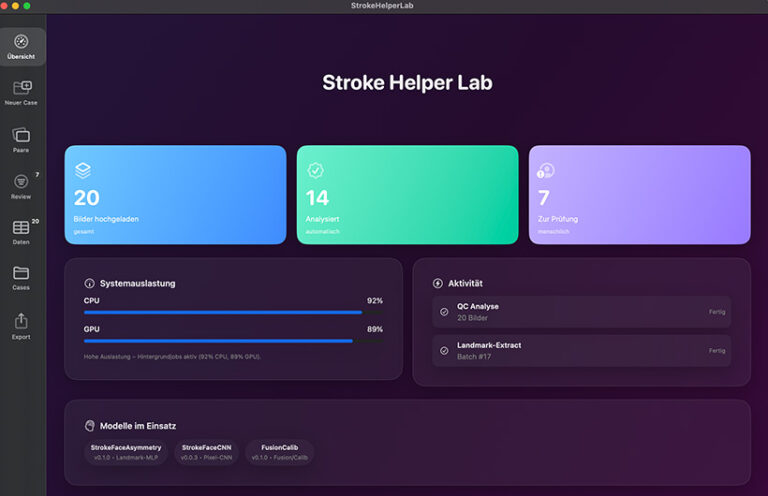
The app analyzes facial features, speech, and selected health data to identify potential abnormalities at an early stage — structured, comprehensible, and available at all times.
In the background, a proprietary AI analyzes imaging, speech, and health data, identifying patterns and changes over time.
The evaluation is structured, data-driven, and traceable.
The protection of sensitive health data is a top priority - processing is performed locally on your device.
Stroke?
Detect. Act. Save.
Designed for emergencies. Easy for everyone to understand.
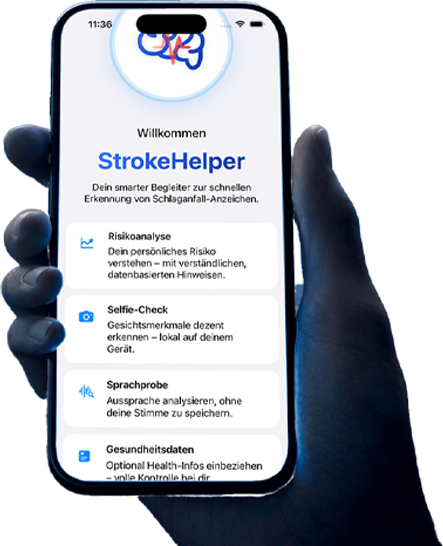
With Stroke Helper*, you can detect possible stroke symptoms within seconds – using facial analysis, speech recognition, and a simple checklist.
*This is a prototype. Learn more here*.
The science behind Stroke Helper
Risk & Awareness
Stroke Helper beginnt nicht erst im Notfall – sondern mit Prävention, Aufmerksamkeit und individueller Vergleichbarkeit.
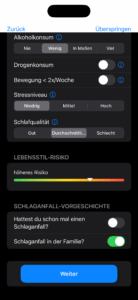
During onboarding, Stroke Helper captures key personal risk factors. These include, among others, age, sex, lifestyle, current medication, thrombotic predisposition, and family history of stroke.
These data are not collected for documentation alone — they are incorporated into the app’s subsequent risk assessment and computational logic.
This establishes an individual baseline that allows for more differentiated interpretation of screening results and enables personalized assessments.
Stroke Helper does not assess symptoms in isolation, but within the context of the individual risk profile.
Facial recognition
Reference captured during onboarding, comparison in everyday use.
During onboarding, Stroke Helper records a personal baseline of facial features. This serves as the reference point for all subsequent analyses. In ongoing use, new recordings are automatically compared with this baseline to detect changes at an early stage.
Selfie (2D analysis)
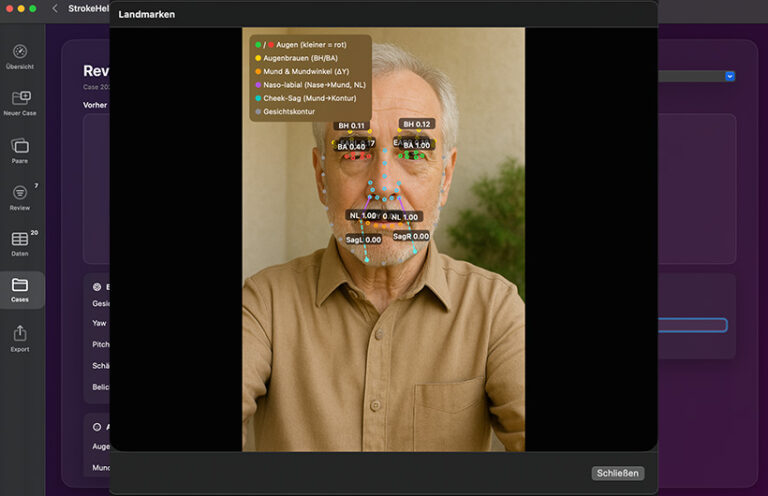
The selfie serves as a visual reference for capturing key facial features such as eye position, mouth corners, the nasolabial region, and facial contours.
In everyday use, new selfies are compared with the initial baseline to identify deviations in symmetry, facial expression, or muscle activity. This 2D analysis enables regular, low-threshold longitudinal monitoring under real-life conditions.
3D Scan
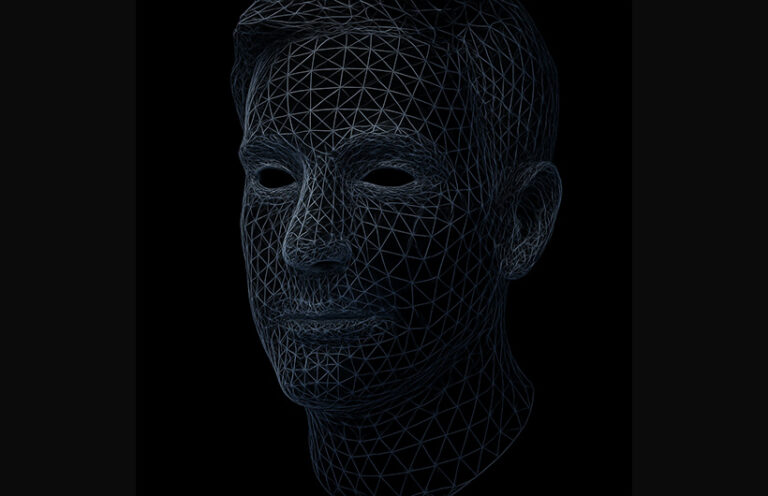
The 3D scan complements the selfie analysis with spatial depth information and structural facial data. It captures volume, contours, and geometric deviations independently of lighting conditions or perspective.
By comparing with the 3D baseline created during onboarding, even minimal asymmetries can be detected with precision that would not be visible in a purely 2D assessment.
Speech recognition
Speech analysis & articulation
Multilinguality & phoneme-based references
During onboarding, targeted speech samples are recorded to capture key parameters such as articulation, speech rate, phonetic precision, and pause structure.
In everyday use, Stroke Helper analyzes new speech recordings against the personal baseline and identifies deviations that may indicate neurological abnormalities, such as emerging dysarthria or speech motor disorders.
Stroke Helper’s speech recognition is not based on translated test sentences, but on language-specific phonetic patterns and structures.
For each supported language, a dedicated reference is established that accounts for typical sounds, syllable sequences, and articulation patterns. This enables language-dependent changes — such as aphasic symptoms — to be detected in a differentiated and valid manner, regardless of the user’s native language.
Checklist
Strukturierte Abfrage neurologischer Auffälligkeiten im Alltag
Die Checkliste (FAST Methode) von Stroke Helper ermöglicht eine gezielte und wiederholbare Abfrage typischer neurologischer Symptome. Sie dient dazu, subjektive Wahrnehmungen systematisch zu erfassen und Veränderungen im zeitlichen Verlauf sichtbar zu machen.
Targeted symptom assessment
Complementing objective analyses
More context. More confidence.
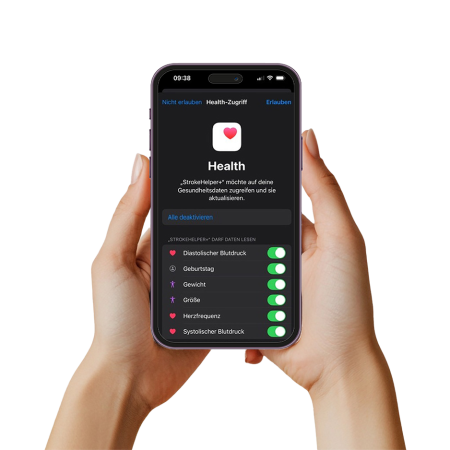
Stroke Helper integrates selected health data from Apple Health to evaluate changes not in isolation, but within the overall context. This provides a robust, data-driven complement to facial and speech analysis.
Heart rate
Changes in heart rate provide important indicators of acute stress and potential neurological events.
Resting heart rate
Notable deviations in resting heart rate may serve as early warning signs of physiological or neurological changes.
EKG 1
ECG data support the detection of cardiac rhythm abnormalities that may be associated with an increased risk of stroke.
Sleep index
Changes in sleep patterns can provide early indications of health stress and neurological disorders.
Blood pressure
Blood pressure values are a key risk factor and essential for assessing stroke risk.
Temperature
Deviations in body temperature may provide additional indications of acute or gradual health changes.
Bipedal support duration
Changes in gait pattern may indicate motor impairments and emerging neurological abnormalities.
Blood oxygen
Reduced oxygen saturation may indicate impaired oxygen supply to the body and the brain.
Stresslevel
Persistently elevated stress levels may increase stroke risk and provide important contextual information for overall assessment.
Simple & user-friendly
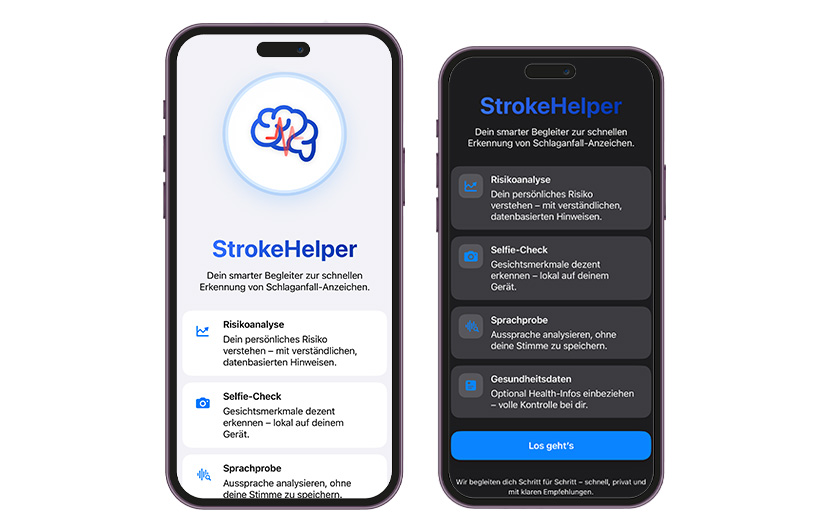
The Stroke Helper interface is designed to remain clear and easy to understand—even in stressful situations. You’re guided step by step through each feature, so you don’t have to spend time thinking or searching. This lets you use the app quickly and safely in an emergency.
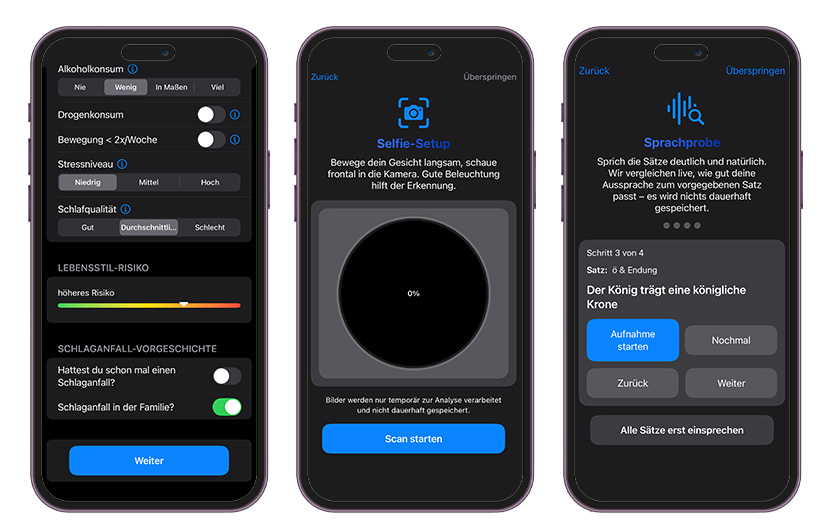
Your personal onboarding
When you first launch Stroke Helper, your personal profile is set up:
You can upload a profile picture, save a short voice recording, and receive an initial risk assessment.
This way, the app is tailored to you right from the start and can recognize symptoms even more accurately later on.
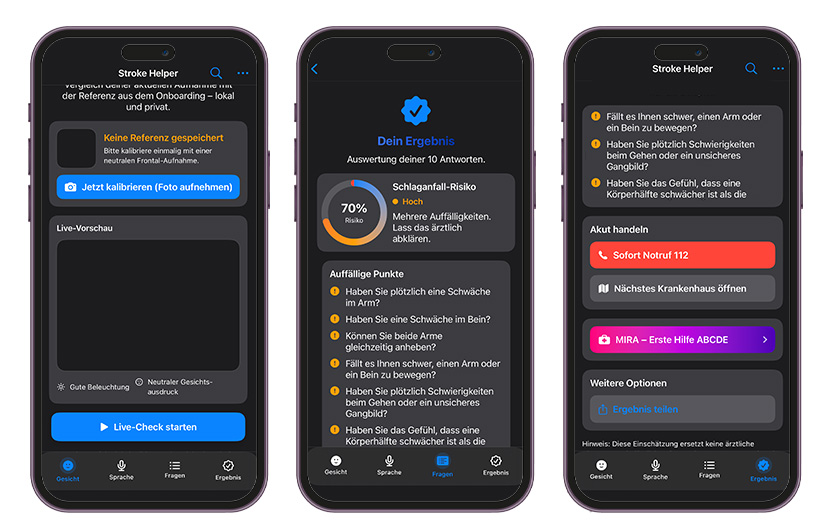
In an emergency, clarity counts
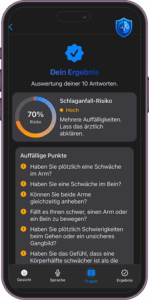
Stroke Helper shows you the result instantly and clearly—so no time is lost.
Whether unremarkable or critical: you know at a glance what to do.
In an emergency, you can call emergency services directly from the app or get step-by-step support from MIRA, the integrated first aid assistant.
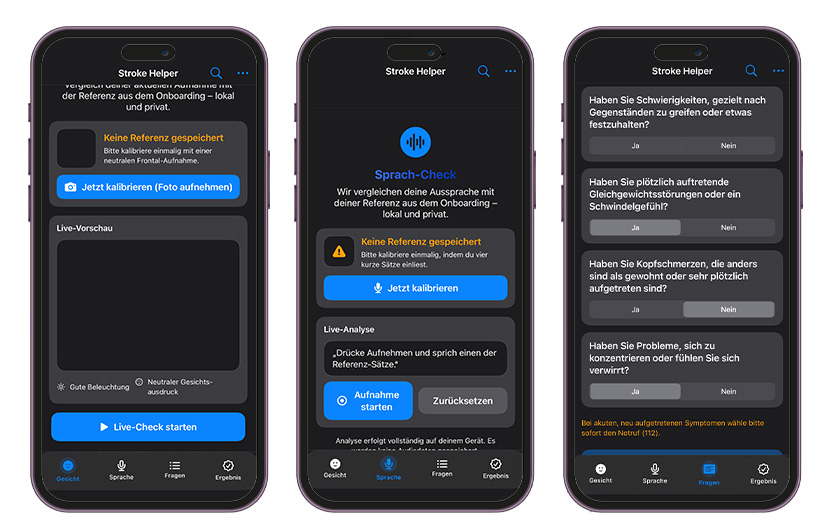
Simple – everything at a glance
Die MainTabView ist dein Ausgangspunkt in Stroke Helper.
Hier findest du alle wichtigen Bereiche wie Gesichtsanalyse, Sprachtest und Checkliste übersichtlich angeordnet.
So hast du jederzeit schnellen Zugriff auf alle Funktionen der App.
The lab behind the scenes
MIRA AI
MIRA AI is the analytical foundation of Stroke Helper and a proprietary in-house development.
Here, data is validated, models are trained, and new features are continuously developed.